Snipes

Another cryptid that I would love to see get some presence in books about the supernatural is the snipe. There are two types of cryptids that are referred to as snipes. One, most commonly found in throughout North America, and the other specific to Arkansas.

I will preface this by saying that there is a real type of bird called a snipe, but this is not what I’m talking about.

The snipe that is hunted in the forests of North America varies in description based on the tall tale of that area. In some places a snipe is a small mammal like a cat or a raccoon. In others it is a bird or a deer like creature. Some describe it like a mix between a jackalope and a squirrel. In all cases the snipe is an illusive creature that must be hunted in a group. The group goes out into the forest together, deep enough to be away from the light of houses or camp. One person is designated to hold the bag and make the ‘snipe call’ while the rest of the party spreads out to flush the animal out. And then the practical joke or hazing ritual part hits and the person with the bag is often abandoned. The practical joke is popular in rural areas and at summer camps. A group of initiated kids (or adults) take the newcomer(s) into the woods and leave them there. Alternately, someone might ‘catch’ the snipe and pretend as if the bag was moving, only for it to explode out of the bag and escape before it can be seen.

My own experience with snipes was a bit different. Growing up in rural PA, I learned about snipes first through my uncle. However, our snipe hunt wasn’t a simple walk in the woods, but a romp arounds the countryside on four wheelers hunting for snipes. Needless to say, we never caught one.

The Arkansas snipe, also known as a Sketeroo, is a giant mosquito-like insect creature that has been known to eat horses and cows whole.

While the snipe is often presented as a practical joke, it could easily be used in a book as a cryptid. The fact that the description varies means that a snipe can be whatever small forest creature you want it to be. It could even be an invisible animal, or one only visible by certain light of the moon. If you include a snipe hunt, you could have the characters catch one or fail to catch one. If caught, there is the potential for all sorts of shenanigans. The potential is endless.

Pennsylania’s Squonk

In populating my fictional town of Locke’s Falls, a haven for supernatural beings, I’ve been trying to flesh out the normal gambit of creatures (werewolves and other were-creatures, vampires, elves) with some more unusual or less commonly used creatures. As the town is set in Pennsylvania, I want to include some local cryptids. In that end, may I present the Squonk.

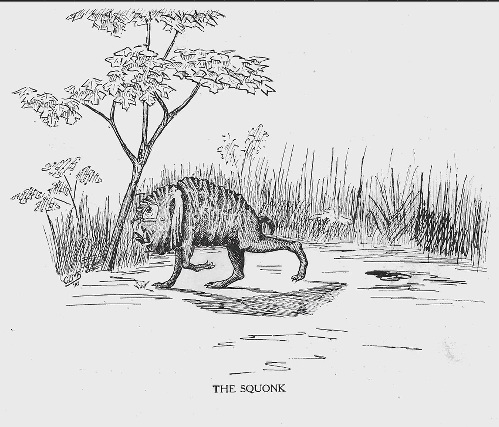
The majestic Squonk can be found in the northern Hemlock forests of Pennsylvania, such as in the Pocono mountain range. It has been described thus:

The squonk is of a very retiring disposition, generally traveling about at twilight and dusk. Because of its misfitting skin, which is covered with warts and moles, it is always unhappy … Hunters who are good at tracking are able to follow a squonk by its tear-stained trail, for the animal weeps constantly. When cornered and escape seems impossible, or when surprised and frightened, it may even dissolve itself in tears.

— William T. Cox, “The Squonk”, Fearsome Creatures of the Lumberwoods (1910)

The Squonk even has its on taxonomy, Lacrimacorpus dissolvens. It’s more recently been described as a tusked pig, covered in warts with cauliflower ear and loose skin. However sad the description may seem, the squonk is well loved in parts of Pennsylvania. Johnstown, PA has a Squonkapalooza festival every year.

In the world of Locke’s Falls, the squonk can occasionally be found wandering the forests surrounding the town. They travel alone or in small family groups. Their diet is mostly scrub, ferns, and other vegetation found of the forest floor, but they are known to get into the occasional farmer’s field. The squonk is only hunted when it becomes a problem to farmers. It has no natural predators as the squonk dissolves into a puddle of tears when surprised, cornered, or injured, and that’s just not a useful expenditure of time for predatory animals. There has been no evidence of anyone catching a squonk alive and no one knows what they might taste like. In general, the squonk is left alone to live its life free of human interference.